Understanding what causes a panic attack can make all of the difference in the world. Once you know what is causing your panic attacks to occur, you will know what to avoid doing. The following article will give you insight into things that often cause people to suffer a panic attack.
Remind yourself during a panic attack that there is nothing wrong with you, your nervous system is just sensitive and reacting to some sort of stimulus. This is only temporary and it will pass, and that you'll survive it and have absolutely no residual problems from the way it affects your body.
Many people are embarrassed or afraid to confide in family members when they suffer from panic attacks. Studies have shown that panic disorder may be hereditary, affecting other members of the family. Talk to your relatives and you may find allies who suffer as you do and can help you deal with this devastating disorder.
Regain control of your breathing by using a paper bag. Alternate 10 breaths into and out of the bag, and then breathe without the bag for about 15 seconds. This will help to regulate your breathing, by building up the carbon dioxide in your body and allowing oxygen levels to come back to normal.
When you begin to feel anxiety, make sure that you do something. Turn on the TV or start writing in a journal. Do not just sit there and let your symptoms get the best of you. When in doubt, do something to occupy your mind to you can relax a bit.
The information that has been provided above should help you better understand what causes you to have a panic attack. If you avoid your known triggers, you should be able to cut back on the number of panic attacks you have. You may even be able to live without another one if you strictly avoid all triggers.
Wednesday, April 10, 2013

Friday, March 22, 2013
Is Your Spouse Depressed? Ways You Can Help
In the confusing world of depression, there are plenty of great resources available to both sufferers and their supporters. There are many programs, e-guides, books, and other resources available. This set of tips contains some of the best advice for helping you feel better by seeking proper treatment for your depression.
Understand that depression exists in many cultures around the world. In Japan, they call some depressed or socially anxious individuals hikkikimori, which are individuals who live entirely at home usually only interacting with a few family members. The rise in the amount of people who close themselves off from society is on the rise as the world becomes increasingly more metropolitan.
Developing interest will help you beat depression. Many people fall into a depression because they don't have anything they really enjoy doing. Having interests and activities that you find enjoyable are very important to your mental health and can raise your self-esteem as well as your happiness. These activities tend to bring a sense of satisfaction as well as keep your mind off anything negative in your life.
Try increasing your Vitamin B's intake to combat depression. Recent studies have shown a link between low levels of this vitamin and depression. Some of the best food sources of Vitamin B include meat, fish, poultry, eggs, fortified breakfast cereal and milk. You can also try taking a B-Complex Vitamin to be sure your are getting the recommended daily amount.
One way to deal with depression is to fake it till you make it. Try to act as though you are not depressed. Really give it a good try and force yourself too. Imagine that you are not depressed and eventually it will come to pass. Basically you are tricking your mind, because if you do it enough, your brain will not know that it is depressed.
After reading these tips, you can begin to understand what it takes to start treating your depression. There is a lot of information to go through and you need to know what to do with it. With this in mind, you can find the treatment that works for you with the help of a physician and these tips.
Understand that depression exists in many cultures around the world. In Japan, they call some depressed or socially anxious individuals hikkikimori, which are individuals who live entirely at home usually only interacting with a few family members. The rise in the amount of people who close themselves off from society is on the rise as the world becomes increasingly more metropolitan.
Developing interest will help you beat depression. Many people fall into a depression because they don't have anything they really enjoy doing. Having interests and activities that you find enjoyable are very important to your mental health and can raise your self-esteem as well as your happiness. These activities tend to bring a sense of satisfaction as well as keep your mind off anything negative in your life.
Try increasing your Vitamin B's intake to combat depression. Recent studies have shown a link between low levels of this vitamin and depression. Some of the best food sources of Vitamin B include meat, fish, poultry, eggs, fortified breakfast cereal and milk. You can also try taking a B-Complex Vitamin to be sure your are getting the recommended daily amount.
One way to deal with depression is to fake it till you make it. Try to act as though you are not depressed. Really give it a good try and force yourself too. Imagine that you are not depressed and eventually it will come to pass. Basically you are tricking your mind, because if you do it enough, your brain will not know that it is depressed.
After reading these tips, you can begin to understand what it takes to start treating your depression. There is a lot of information to go through and you need to know what to do with it. With this in mind, you can find the treatment that works for you with the help of a physician and these tips.
Sunday, March 10, 2013
Simple And Effective Stop Smoking Strategies That Are Successful
Quitting smoking is important for your health and the health of your family. Although it is not easy to quit, quitting tobacco is something that must be done. Use the helpful tips in the article below to quit smoking so you can save money, live longer and smell better.
Learn some deep breathing techniques and practice them when you feel the craving for a cigarette. When you feel the urge for a smoke, take a few minutes and breathe deeply through your nose, hold it, and exhale through your mouth. Repeat this until the need for a cigarette has gone away.
Remember that the hardest part of quitting is usually those first couple of days. Mentally prepare yourself to tough it out for just the first two days, and then just the first week, and you will probably be in good shape after that. Your body will be doing a good amount of detoxifying in those first few days and if you can make it through that stage, you can make it through anything.
You may want to think about getting acupuncture done to quit smoking. This method involves the acupuncturist using small needles and inserting them into the pressure points in your body that control your urge to smoke. Some acupuncturists even accept insurance, as long as quitting will help a pre-existing medical condition.
Perform deep breathing exercises for around three to five minutes every single day in order to help you relax when trying to quit smoking. Always breathe in through the nose, hold this for several seconds, and exhale slowly through the mouth. This method is extremely effective for eliminating smoking from your life.
As stated in the beginning of this article, quitting smoking is very important and something that should not be put off any longer. If you want to live a long and healthy life, quitting smoking is imperative. Use the tips in this article for some helpful ideas to quit smoking.
Learn some deep breathing techniques and practice them when you feel the craving for a cigarette. When you feel the urge for a smoke, take a few minutes and breathe deeply through your nose, hold it, and exhale through your mouth. Repeat this until the need for a cigarette has gone away.
Remember that the hardest part of quitting is usually those first couple of days. Mentally prepare yourself to tough it out for just the first two days, and then just the first week, and you will probably be in good shape after that. Your body will be doing a good amount of detoxifying in those first few days and if you can make it through that stage, you can make it through anything.
You may want to think about getting acupuncture done to quit smoking. This method involves the acupuncturist using small needles and inserting them into the pressure points in your body that control your urge to smoke. Some acupuncturists even accept insurance, as long as quitting will help a pre-existing medical condition.
Perform deep breathing exercises for around three to five minutes every single day in order to help you relax when trying to quit smoking. Always breathe in through the nose, hold this for several seconds, and exhale slowly through the mouth. This method is extremely effective for eliminating smoking from your life.
As stated in the beginning of this article, quitting smoking is very important and something that should not be put off any longer. If you want to live a long and healthy life, quitting smoking is imperative. Use the tips in this article for some helpful ideas to quit smoking.
Thursday, January 24, 2013
Tobacco Fact

Tobacco Fact:
Did you know that almost all of the cigarette manufacturers use "reconstituted" tobacco and nicotine?
Pushing the flaky tobacco leaves into paper cigarette tubes is a messy job, and ends up creating tobacco leaf litter all around the processing plants. The cigarette makers sweep all of this litter up, pull the chemicals from the leaves, spray them onto paper, shred the paper, and mix this in with real tobacco leaves. Gross, of course, but what isn't gross about a smoking habit?
Monday, December 17, 2012
12 Steps to RX Drug Recovery

Above It All Treatment, a drug rehab utilizing the 12 step addiction recovery method, has seen a large increase in enrollments to fight addictions to painkillers such as hydrocodone, percocet, and oxycodone. Individuals often cite the availability of the drugs as the original reason they began using the drugs.
For treatment options for addiction to prescription drugs, visit aboveitalltreatment.com.
Friday, November 30, 2012
Persistent Addiction: A Problem That Grows

Studying addictions is a relatively new medical practice. Learning about how addictions work on the human mind has grown to a more popular practice because the insights we gain can also give us insights on how to better treat addiction.
One interesting insight that we have gained recently is that addiction constantly grow more severe, whether or not drugs are being ingested. This is beneficial information because it explains why a recovering addict -- with years of sobriety -- that relapses, plunges deeply back into the throes of addiction. 12 step treatment centers have now adopted this discovery into their treatment programs and it has become a very good deterrent from further drug use. In short, an addict that knows that a relapse will result in a wrenching, more devastating detox and rehabilitation the next time around.
Still, the study of addiction will continue to unveil new discoveries about the nuances of addiction, and drug rehabs will have more information and tools to utilize that aid in the recovery of individuals with chemical dependencies.
Monday, November 19, 2012
Programs That Inspire Wellness and Health

When enrolling in a chemical dependency treatment program, the main goal is to win the battle over addiction to drugs and/or alcohol. Within these programs, underlying conditions and unhealthy lifestyles can also be treated, offering the patient a new outlook on their own health and well-being as well.
What is chemical dependency? If you truly think about it, a chemical dependency is the dependency on a certain drug to obtain feelings of normalcy; through holistic nutrition programs and other programs that promote natural health and wellness, patients can learn new ways to sate the cravings for fulfillment that originally led them to consider illicit drugs as an option.
New Dawn Recovery of Northern California uses this strategy in many of its dual diagnosis residential treatments. By acknowledging that there was an underlying feeling of inadequacy that the patient felt prior to -- and eventually leading them to -- drug and alcohol use, those underlying issues can be addressed, and the patient can find natural and healthy ways to address the issues without having to resort to chemicals for fulfillment.
With a well-rounded strategy for treatment, New Dawn strives for a more successful period of treatment that will equip its patients with the necessary skills to go forth in life and have natural and healthy outlets for their inherent cravings. This approach breeds a more successful treatment, as well as creates an additional defense against relapse and future struggles.
New Dawn has four locations around the Bay Area of San Francisco:
New Dawn Recovery Center: Citrus Heights #1
New Dawn Recovery Center: Citrus Heights #2
New Dawn Recovery Center: Sausalito #1
New Dawn Recovery Center: Sausalito #2
Monday, October 29, 2012
Ending Addiction For Good

Addiction has often been called a cycle... "The cycle of addiction" is the phrased often used when speaking of intervention, the treatment of addiction, or sober living. While it is true that addiction can lead to a cycle of addiction>sobriety>addiction, the truth is that calling it cycle does not offer much hope for those wanting to end addiction.
Simply using inspiring words like "end" can strip away the negative ties and offer a more hopeful and definitive message to those who need to hear it the most. Whether you need long term drug treatment or simply outpatient drug treatment, the message of hope could be the strongest factor in a successful triumph over addiction.
In drug addiction counseling, the message is: "It ends here, it ends today."
If you are ready to end addiction today, visit Drug Addiction Treatment for more information and available programs. Visit the official Drug Addiction Treatment website at:
| http://www.drugaddictiontreatment.com |
Wednesday, September 26, 2012
Emotional Stages of Addiction
Addiction to alcohol, sex, food, or an illegal substance doesn't happen overnight. Little by little, a person may get involved with the bad habit until one realizes that he or she is mentally obsessed or emotionally compelled. But as addiction develops through time with frequent use or mismanaged behavior, lifetime recovery from addiction proves to be an emotional roller coaster ride. Even after detoxification or therapy, there's a good chance that the patient will suffer from a relapse without continued support from family and friends, strong will, and determination. The patient goes through confusing emotional states as he or she progresses with full-term recovery. Here are some of the emotional stages one has to go through:
Denial
At first, one would deny the fact that he or she might be suffering from addiction and would make excuses to cover for his or her acts. One would hide it from his or her family and make it seem like everything's perfectly normal.
Anger
When confronted or asked about the symptoms of his or her addiction, one tends to be defensive and would argue to justify his or her actions. An addict may even block out some family and friends and try to resolve the problem on his or her own. Often, an addict would blame others for his or her wrongdoings, turn away, and leave, instead of addressing the problem at hand. There's a feeling of resentment, which can be followed shortly by depression.
Bargaining
Seeing how his or her condition is affecting one's career, relationships, and personal life, an addict may promise not to do it again, but falls to the bad habit anyway. It is not easy to abstain from addiction all at once. This will take great will and determination, and without support from family and friends, recovery will be nearly impossible.
Depression
Unable to finally put a stop to the bad habit that's been causing a strain on one's family and personal life, an addict may feel that he or she has no choice or control over things. He or she then falls into depression. Any depressed individual would have trouble making the best decisions and would often isolate him or herself. But with the help of concerned family or friends, he or she may eventually be pulled out of anxiety, fear, and guilt.
Acceptance
Acceptance is often the first step to recovery. By admitting that one has a problem, he or she will be able to seek professional help and commit to the addiction program. Relapse often tests the recovery stage, but by believing in one's self, knowing the risks, and addressing the root of the problem, this can be overcome so full-term recovery can take its place in the person's life. An effective recovery program seeks to reinforce abstinence, personal growth, and necessary lifestyle changes.
Article above provided by recovery connections
Friday, October 8, 2010
QUESTION: What are the health risks of chewing tobacco as compared to smoking?
ANSWER: Some people who have been persuaded to give up smoking have ended up placing the tobacco directly inside their mouth instead—in the mistaken belief that smokeless tobacco (a.k.a. spit tobacco, chew, chaw, dip, plug, etc.) is less toxic and dangerous. In 2004, about 3% of American adults used spit tobacco. This percentage is likely to increase as more public establishments enforce smoking bans across the country.
Users can get their tobacco fix by “dipping” snuff (a fine tobacco, either moist or dry is held between the bottom lip or cheek and gum) or chewing (a wad of leaves, either shredded, twisted or in brick form, is placed between the cheek and gum). If you hold an average-sized plug in your mouth for 30 minutes, you’ll end up with as much nicotine as if you had smoked four cigarettes.
Smokeless tobacco includes more than 28 cancer-causing substances, including the tobacco-specific carcinogen nitrosamines. Some products also contain more than 3,000 chemicals. But that’s not all: Because tobacco often has an unpleasant taste, smokeless brands tend to be loaded with sugar, and that leads to tooth decay. The gritty material in the tobacco leaves wears down the surfaces of the teeth, stains the enamel and scratches the soft tissues in the mouth, allowing the nicotine and other chemicals to enter the blood stream directly. As an added bonus, your gums will likely recede, and you’ll develop oral lesions, a black hairy tongue and bad breath. Some smokeless tobacco products also contain salt that can raise blood pressure in vulnerable persons and may cause kidney disease.
I haven’t even mentioned cancer yet: Long-term snuff users have a 50% higher incidence of cancer of the mouth and pharynx, as well as more malignancies of the larynx and esophagus.
And here’s something you may not have considered: Tobacco chewers must spit—and thereby spread their germs to the rest of us. (About one in three Major League baseball players chew, and if you’ve ever watched a ballgame, you know it’s not pretty.)
The bottom line? If you chew, you have not kicked the nicotine habit. The smoking-cessation products approved by the FDA, such as gum and patches, are the safest available sources of nicotine for those trying to quit. There’s also tobacco-free snuff made from mint, clover, tea or alfalfa.
(Answered by: www.parade.com)
Users can get their tobacco fix by “dipping” snuff (a fine tobacco, either moist or dry is held between the bottom lip or cheek and gum) or chewing (a wad of leaves, either shredded, twisted or in brick form, is placed between the cheek and gum). If you hold an average-sized plug in your mouth for 30 minutes, you’ll end up with as much nicotine as if you had smoked four cigarettes.
Smokeless tobacco includes more than 28 cancer-causing substances, including the tobacco-specific carcinogen nitrosamines. Some products also contain more than 3,000 chemicals. But that’s not all: Because tobacco often has an unpleasant taste, smokeless brands tend to be loaded with sugar, and that leads to tooth decay. The gritty material in the tobacco leaves wears down the surfaces of the teeth, stains the enamel and scratches the soft tissues in the mouth, allowing the nicotine and other chemicals to enter the blood stream directly. As an added bonus, your gums will likely recede, and you’ll develop oral lesions, a black hairy tongue and bad breath. Some smokeless tobacco products also contain salt that can raise blood pressure in vulnerable persons and may cause kidney disease.
I haven’t even mentioned cancer yet: Long-term snuff users have a 50% higher incidence of cancer of the mouth and pharynx, as well as more malignancies of the larynx and esophagus.
And here’s something you may not have considered: Tobacco chewers must spit—and thereby spread their germs to the rest of us. (About one in three Major League baseball players chew, and if you’ve ever watched a ballgame, you know it’s not pretty.)
The bottom line? If you chew, you have not kicked the nicotine habit. The smoking-cessation products approved by the FDA, such as gum and patches, are the safest available sources of nicotine for those trying to quit. There’s also tobacco-free snuff made from mint, clover, tea or alfalfa.
(Answered by: www.parade.com)
Wednesday, September 29, 2010
Addiction: defined
Historically, addiction has been defined with regard solely to psychoactive substances (for example alcohol, tobacco and other drugs) which cross the blood-brain barrier once ingested, temporarily altering the chemical milieu of the brain.
Many people, both psychology professionals and laymen, now feel that there should be accommodation made to include psychological dependency on such things as gambling, food, sex, pornography, computers, video games, internet, work, exercise, idolising, watching TV or certain types of non-pornographic videos, spiritual obsession, pain, cutting and shopping so these behaviors count as 'addictions' as well and cause guilt, shame, fear, hopelessness, failure, rejection, anxiety, or humiliation symptoms associated with, among other medical conditions, depression and epilepsy.
(**Wikipedia)
-----------------------------------
Need addiction services ?
-----------------------------------
Many people, both psychology professionals and laymen, now feel that there should be accommodation made to include psychological dependency on such things as gambling, food, sex, pornography, computers, video games, internet, work, exercise, idolising, watching TV or certain types of non-pornographic videos, spiritual obsession, pain, cutting and shopping so these behaviors count as 'addictions' as well and cause guilt, shame, fear, hopelessness, failure, rejection, anxiety, or humiliation symptoms associated with, among other medical conditions, depression and epilepsy.
(**Wikipedia)
-----------------------------------
Need addiction services ?
-----------------------------------
Tuesday, September 21, 2010
Blew it.
Well, thanks to my boss I am back to a pack and a half as of today... can't say I wasn't trying. Maybe I need to take up yoga or something to help with the stress. I have also heard that having carrot sticks or stick pretzels around help or even knitting because it keeps your hands busy.
I am going to have to try something to kick this habit.
----------------------------------------------
Do you need an addiction counselorto help?
----------------------------------------------
I am going to have to try something to kick this habit.
----------------------------------------------
Do you need an addiction counselorto help?
----------------------------------------------
Thursday, September 16, 2010
What is nicotine addiction?
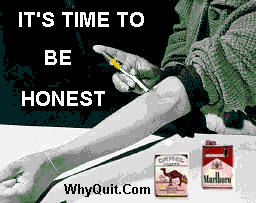 Nicotine is the tobacco plant's natural protection from being eaten by insects. It is a super toxin that, drop for drop, is more lethal than strychnine or diamondback rattlesnake venom, and three times deadlier than arsenic. Yet, amazingly, by chance, this natural insecticide's chemical signature is so similar to the neurotransmitter acetylcholine that once inside the brain it fits a host of chemical locks permitting it direct and indirect control over the flow of more than 200 neuro-chemicals.
 Within ten seconds of that first-ever inhaled puff, possibly through dizzy, coughing and six shades of green, nicotine arrived at the brain's reward pathways where it generated an unearned flood of dopamine, resulting in an immediate yet possibly unrecognized "aaah" reward sensation. Sensing it would cause most first-time inhalers to soon return to steal more. Nicotine also activated the body's fight or flight pathways releasing adrenaline, and select serotonin pathways impacting mood and impulsivity.
(**Find more at whyquit.com)
You can overcome addiction!
Tuesday, September 7, 2010

Wednesday, August 25, 2010
Starting Younger and Younger
I have a confession. My friend and I started experimenting with smoking at a very young age. We started with stupid stuff we could find around the house, and let me tell you even though most teas are herbs- they do not smoke very well.
Now I am a chain smoker, smoking about a pack to a pack and a half a day. And I am trying to quit, I watched my boyfriends grandmother die of COPD, basically suffocating to death as parts of her lungs died. I don't want to go that way.
So here I will share my progress to quitting and other tid-bits about drugs in general, their addictiveness, success stories, as well as covering both legal and illegal types.
Thanks for the support~ Ellcie
Now I am a chain smoker, smoking about a pack to a pack and a half a day. And I am trying to quit, I watched my boyfriends grandmother die of COPD, basically suffocating to death as parts of her lungs died. I don't want to go that way.
So here I will share my progress to quitting and other tid-bits about drugs in general, their addictiveness, success stories, as well as covering both legal and illegal types.
Thanks for the support~ Ellcie
Subscribe to:
Posts (Atom)